
BLOG Post - Building Strong Number Foundations: Understanding Dyscalculia and Supporting Early Mathematical Development
.png)

Celebrating Our Maths Champions
This year, we're incredibly proud that our Early Years Practitioners and Educators completed the NDNA Maths Champions Programme—a nationally recognised professional development programme designed to strengthen mathematical teaching and learning in the early years.
The programme equips educators with the knowledge, confidence and practical strategies to embed mathematical thinking into children's everyday experiences, helping to build strong foundations for lifelong learning. At COG, this reflects our belief that maths is much more than counting or recognising numbers—it's about exploring patterns, solving problems, making comparisons and understanding the world around us through play and meaningful interactions.
By investing in our team's professional development, we're ensuring every child benefits from high-quality mathematical experiences everyday. Just as importantly, our educators are better equipped to recognise when a child may be finding early mathematical concepts challenging, allowing us to provide timely support and work in partnership with families to help every child thrive.
When we think about early childhood education, we often picture children learning to recognise letters, tell stories and explore the world through play. But did you know that some of the most important mathematical learning also happens during these early years?
Long before children begin formal maths lessons at school, they are developing something known as number sense—the ability to understand numbers, quantities and patterns in everyday life. These early experiences lay the foundation for future mathematical success and can also help identify children who may need additional support.
What is dyscalculia?
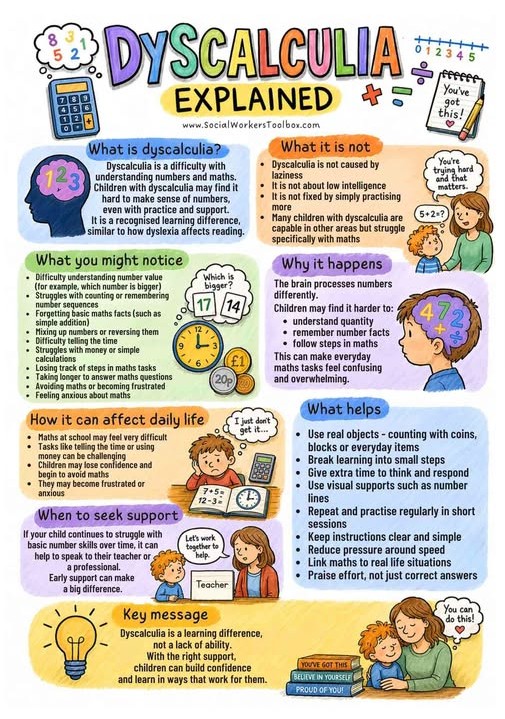
Dyscalculia is a specific learning difference that affects a person's ability to understand numbers and mathematical concepts. It is sometimes described as the maths equivalent of dyslexia, although the two conditions are different.
Children with dyscalculia often find it difficult to develop an intuitive understanding of numbers, even when they have received appropriate teaching and have average or above-average intelligence. They may struggle with recognising quantities, remembering number facts, estimating amounts, or understanding mathematical relationships.
While dyscalculia is typically identified once children begin formal schooling—usually between the ages of 6 and 9—many of the early signs can be observed much earlier.
Early signs to look out for
In the preschool years (ages 3–6), children are naturally developing their understanding of numbers through play and everyday experiences. While every child develops at their own pace, some persistent difficulties may indicate that a child could benefit from closer observation and additional support.
Some early signs include:
- Difficulty learning to count in the correct order.
- Frequently skipping numbers while counting.
- Struggling to connect number words (such as "three") with the written numeral (3) or a group of three objects.
- Difficulty understanding concepts such as "more," "less," "bigger," and "smaller."
- Challenges recognising simple patterns or sorting objects by size or quantity.
- Difficulty understanding everyday concepts of time, such as yesterday, today and tomorrow.
- Finding it harder than expected to compare groups of objects or estimate quantities.
It's important to remember that these signs do not automatically mean a child has dyscalculia. Young children develop at different rates, and many simply need more time and opportunities to practise these skills. However, recognising persistent challenges early allows educators and families to provide additional support before difficulties become more significant.
Why early mathematical experiences matter
Young children don't learn maths by sitting at a desk completing worksheets.
They learn through meaningful, hands-on experiences that happen throughout the day.
When children pour water between containers, build towers, sort blocks by colour, share fruit at morning tea or count the steps to the playground, they are developing vital mathematical thinking.
These everyday experiences help children understand:
- Counting and one-to-one correspondence
- Comparing quantities
- Recognising patterns
- Measuring and estimating
- Sequencing and ordering
- Spatial awareness
- Problem-solving
- Mathematical language
The more opportunities children have to explore these concepts naturally, the stronger their mathematical foundations become.
How COG supports early mathematical development
At COG, we believe that maths should be experienced, not simply taught.
Rather than limiting mathematics to dedicated group times, our educators intentionally weave mathematical thinking throughout every part of the day.
You might see children:
- Counting leaves collected during outdoor play.
- Sharing resources equally with friends.
- Comparing the heights of block towers.
- Sorting natural materials by shape, size or colour.
- Exploring patterns through art and loose parts.
- Measuring ingredients during cooking experiences.
- Using positional language during obstacle courses.
- Talking about time during daily routines.
These rich, play-based experiences allow children to develop confidence with numbers in meaningful and enjoyable ways.
Observing, responding and supporting early
Embedding mathematics into everyday learning also gives educators valuable opportunities to observe how each child approaches number concepts.
Because these experiences occur naturally throughout the day, educators can notice patterns over time—who confidently recognises quantities, who enjoys counting, and who may be finding some concepts more challenging than expected.
When concerns arise, educators can:
- Provide additional one-to-one support.
- Offer more hands-on mathematical experiences.
- Adapt learning to suit each child's needs.
- Work closely with families to share observations and strategies.
- Recommend further assessment where appropriate if concerns persist.
Early identification doesn't mean labelling children. It means ensuring they receive the right support at the right time, helping them build confidence before frustrations develop.
Every child can become a confident mathematician
Mathematical learning isn't about memorising numbers or completing worksheets.
It's about making sense of the world.
By creating environments rich in mathematical language, opportunities and play, we help children develop the confidence, curiosity and problem-solving skills they need for lifelong learning.
At COG, every shared snack, every block tower, every nature walk and every game becomes an opportunity to build mathematical understanding.
Because when maths is part of everyday life, children learn that numbers are not something to fear—they're something to explore.
And for children who may need a little extra support, those everyday moments help us recognise challenges early, respond thoughtfully and ensure every child has the opportunity to thrive.


.svg)

